


Measure and Improve Your Team's Effectiveness
Run a health-check with Google's 5 team effectiveness dynamics

Inspired by:
Julia Rozovsky, People Operations Leader at Google
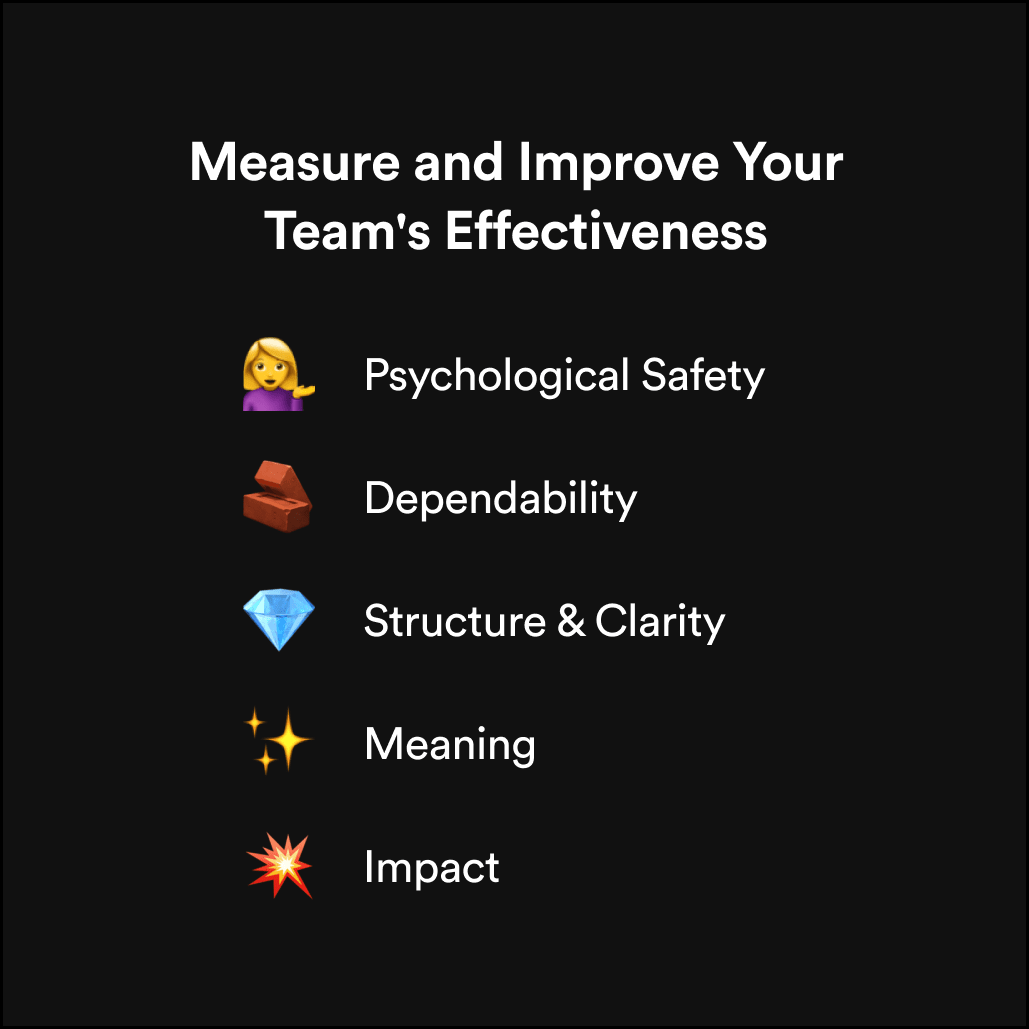
Measure and Improve Your Team's Effectiveness
The effectiveness of a team depends on how well everyone works together. It’s like different parts of a car – when every part works at its optimum level, the car runs smoothly. So, what can you do to measure and improve the overall effectiveness of your team?
In a Google study of 180 teams, they identified 5 key factors for team effectiveness. Here they are in order of importance:
- Psychological Safety 💁
- Dependability 🧱
- Structure & Clarity 💎
- Meaning ✨
- Impact 💥
Let's check out some tools to measure and improve each one!
1. Psychological Safety 💁
It’s creating an environment where team members feel able to voice their opinions, ideas, and concerns openly, even if it goes against the group. Fostering psychological safety reveals blind spots and encourages innovation, so ask yourself:
• Do people ask questions and suggest ideas (even if they seem silly)? • Are team members voicing their concerns? • Do people frequently give and ask for constructive feedback?
To build psychological safety try: • Proactively asking for opposing viewpoints • Using phrases like “Yes, and...” instead of “No, but” • Opening up and owning your mistakes
2. Dependability 🧱
When members on the team are dependable and proactive, everyone succeeds. To measure it in your team, ask yourself:
• Can you count on each other to deliver high-quality work on time? • Do team members proactively share progress and blockers? • Are they taking ownership of key deliverables and decisions?
Set up a "handover" channel in Slack or your project management tool where team members can communicate updates and "pass the ball" to one another.
3. Structure & Clarity 💎
• Do the team know what the goals and priorities are? • Does everyone have clarity on what they’re supposed to do? • Do they know how their performance will be measured?
To bring some structure and clarity make sure to: Get together with your team and plan your projects in smaller chunks, agree on who owns what and define what “done” looks like. Add this to your project management tool so that everyone can stay on track.
4. Meaning ✨
People perform more effectively when they can find meaning in their work: What I do matters.
• Does everyone in the team know the purpose of their work? • Is your team personally invested in their projects? • Are you giving people work based on interest as well as skills and experience?
In 1:1s, ask team members to rate their current projects/tasks on a scale of 1-10 to understand: • If they're being challenged • If they're being used to their full potential • How much their work interests them
Then ask them “What could get it to a 10?” for each project.
5. Impact 💥
This is when your team knows that their work moves the needle on higher-level goals. Ask yourself: • Can your team members tell you what positive change their work enables? • Are they working on what’s important rather than just what’s urgent? • Do they appear energetic or burnt-out?
Here are a few things you can try to increase your team’s impact: • In your 1-on-1s, recognize the impact their work had on a team goal. • Invite your team into the initial planning processes.
What gets measured gets managed
Now that you know what to look for, set up time in your calendar every month to review these questions - you can even turn this into a monthly survey to get your team’s perspective.
Then give yourself 1 or 2 initiatives to focus on the dynamic that you feel has the most to improve. Just remember to start with psychological safety and work your way down.
Now, let’s get that car running smoothly!
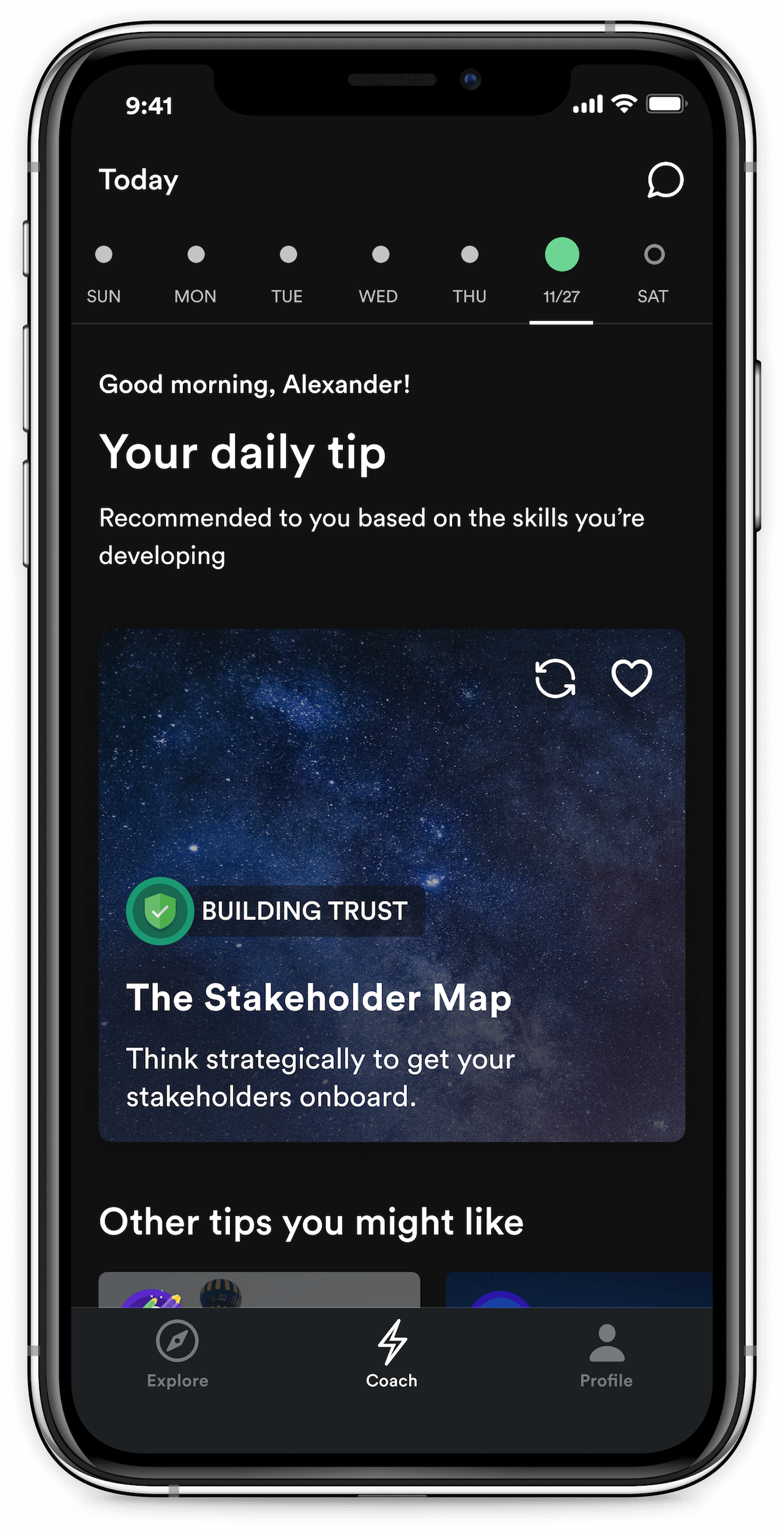
Become a world-class leader in two minutes a day