


Getting to the Root of a Conflict
What to do when things are getting personal.

Inspired by:
Chris Argyris, Business Theorist and former professor at Harvard Business School
Getting to the Root of a Conflict
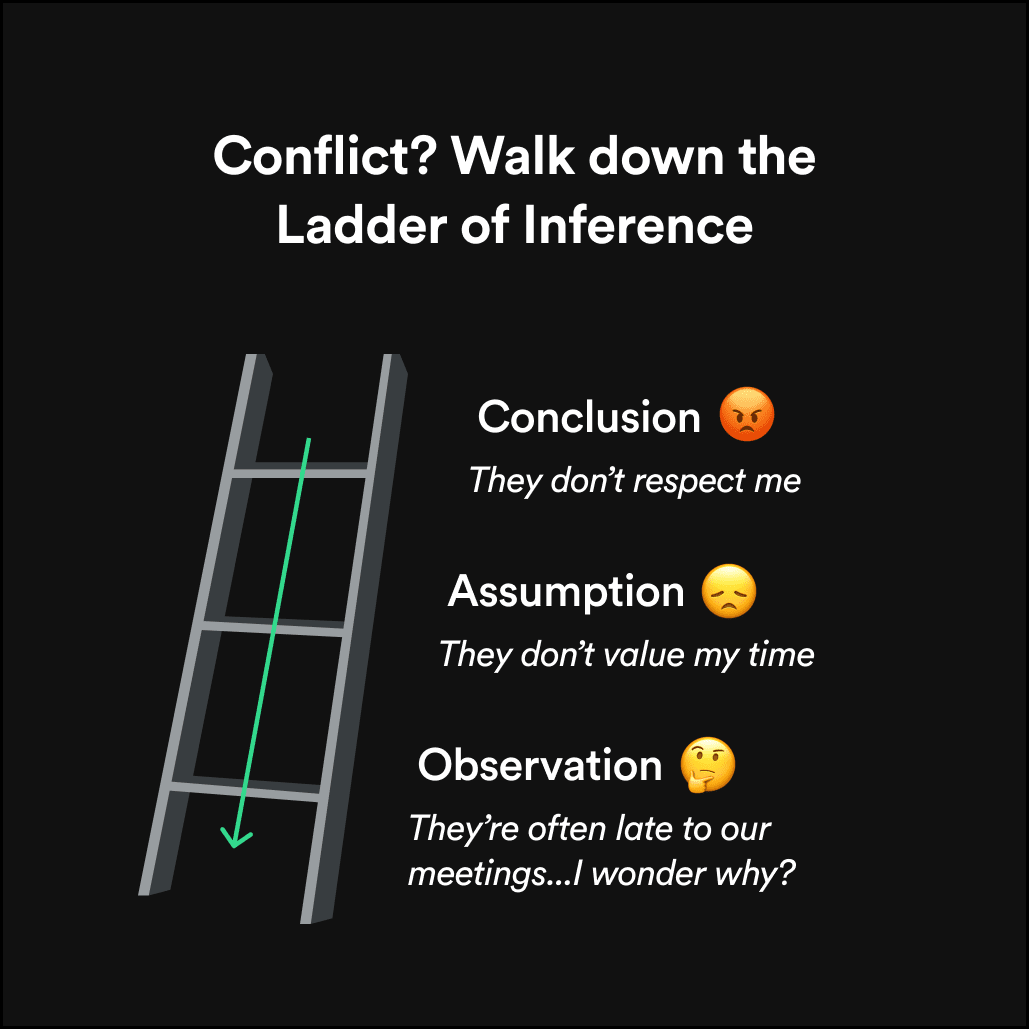
How would you feel if your colleague consistently showed up late to your meetings? Maybe you’d assume that they don’t value your time, but what if you’re missing something?
Many tensions like this escalate or go unresolved for weeks because we stay at a surface level.
Luckily, Chris Argyris, a former professor at Harvard, developed a tool called the Ladder of Inference that can get you out of this situation and get to the real root of the conflict. Let’s take a look:
The Ladder of Inference
Think about a conflict and imagine your views as rungs on a ladder starting at the top
• Conclusion: This is the judgment you’ve come to. • Assumption: Beliefs you think are true, but often without proof • Observation: Objective things you’ve noticed.
In conflicts, people have a tendency to stay at the conclusion level. But if you want to get to the core of the problem, you need to walk down your ladders together, by sharing your observations and assumptions.
Scenario: Being late to meetings
Team member A:
• Observation - They're often late for our meetings • Assumption - They don't care about being on time • Conclusion - They don't care about me, they don't respect me
Team member B:
• Observation - Growing up I learned that finishing things is important and often more difficult than starting. • Assumption - I don’t like being late, but it's better to overrun a meeting than leaving loose ends and not making decisions. • Conclusion - I'm outcome-driven.
Getting to the root
Share your own ladder of inference and invite them to do the same. For example, “I’ve noticed you’re often late to our meetings, which makes me feel like you don’t respect me. I’m probably missing something - what’s going on for you?”
In this situation, having an honest conversation about our observations, assumptions and conclusions reveal two different interests:
- Starting and finishing on time
- Getting valuable outcomes
Getting to resolution
Now you understand each other’s needs, here are a few things you might do to begin resolving the conflict:
• Add buffer time between meetings • Timebox discussions to keep things on track • Use a “parking lot” to collect important ideas but are out of scope • Proactively reach out if a meeting is running over
Confronting conflict can be uncomfortable, but leaving things unresolved is usually worse. Next time you’re exhausted by an argument and tempted to just “agree to disagree”, push yourself to go back to your observations to reveal the true reason for the conflict - your relationships will be better off for it.
Become a world-class leader in two minutes a day