


Creating Space for People to Speak Up
Increase psychological safety in your team.

Inspired by:
Amy Edmondson, Author of "The Fearless Organization: Creating Psychological Safety in the Workplace for Learning, Innovation, and Growth"
Why does no-one speak up?
As a leader, it can be hard to get people to speak up. No one likes to be wrong, look stupid in front of their peers, and be seen as a cynic.
Yet when people don’t speak up, the whole organization suffers: • People keep bad news to themselves • Ideas come from the same people • People don’t call out risks
Amy Edmondson, author of “The Fearless Organization” says to combat this, it starts with psychological safety: “The shared belief that one will not be punished or humiliated for speaking up with ideas, questions, concerns or mistakes.”
So how do you create psychological safety? Through continuous reinforcement. Here's how:
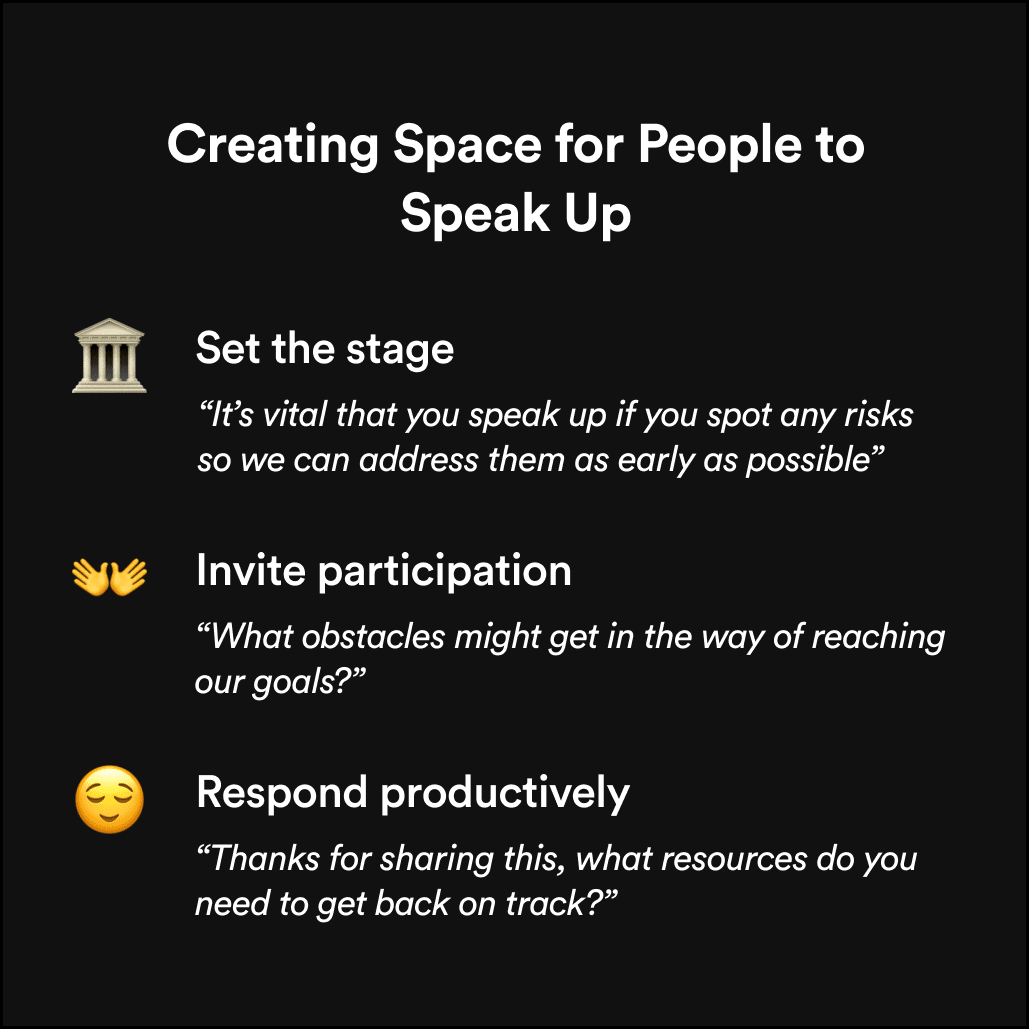
Set the stage
As a leader, you can create a productive context for addressing issues and concerns by saying things like: “This project will be challenging and has many moving pieces. It’s vital that you speak up if you spot any issues or red flags so we can address them as early as possible.”
Making an effort to give permission to speak up shows that you’re more interested in overcoming mistakes than dwelling on them or finding someone to blame.
Invite participation
Ask questions like: • “What risks do you see with this project?” • “What kinds of obstacles do you expect to confront in working towards our goals?” • “What are the top challenges for this project?”
By doing so, you make your team feel like they’re a part of the process and not just there to do what they’re told. You may also learn something new - as your team can help you cover your blind spots, and raise issues you might miss.
Respond productively
It’s ok to be disappointed. It’s not ok to get mad or your team will be too afraid to bring up important concerns in the future.
When you’re presented with a problem, aim for a solution rather than for someone or something to blame. For example, if a team member comes to you with a delayed project, take a breath and focus on support: “Thanks for sharing this, what resources do you need to get back on track?”
Keep it up!
To truly create an environment that feels psychologically safe, you need to continuously reassure people it’s okay, be a role model by bringing up concerns yourself, and thank people when they are brave enough to call out risks.
Once you do this you and your team will address issues early, learn faster, and be equipped to reach even more ambitious goals!
Become a world-class leader in two minutes a day