


Navigating International Cultural Differences
Create a culture of belonging in your global team.
Inspired by:
Tsedal Neeley, Professor at Harvard Business School, Author of "Remote Work Revolution: Succeeding From Anywhere"
Navigating International Cultural Differences 🌍
In today’s global workplace, dealing with cultural differences is more the rule than the exception. Team members are coming onboard with radically different approaches to authority, giving and receiving feedback, to resolving conflict with colleagues - to name just a few.
How can you smooth out miscommunication before it escalates? What can you do to create a culture of belonging?
Introducing the SPLIT framework
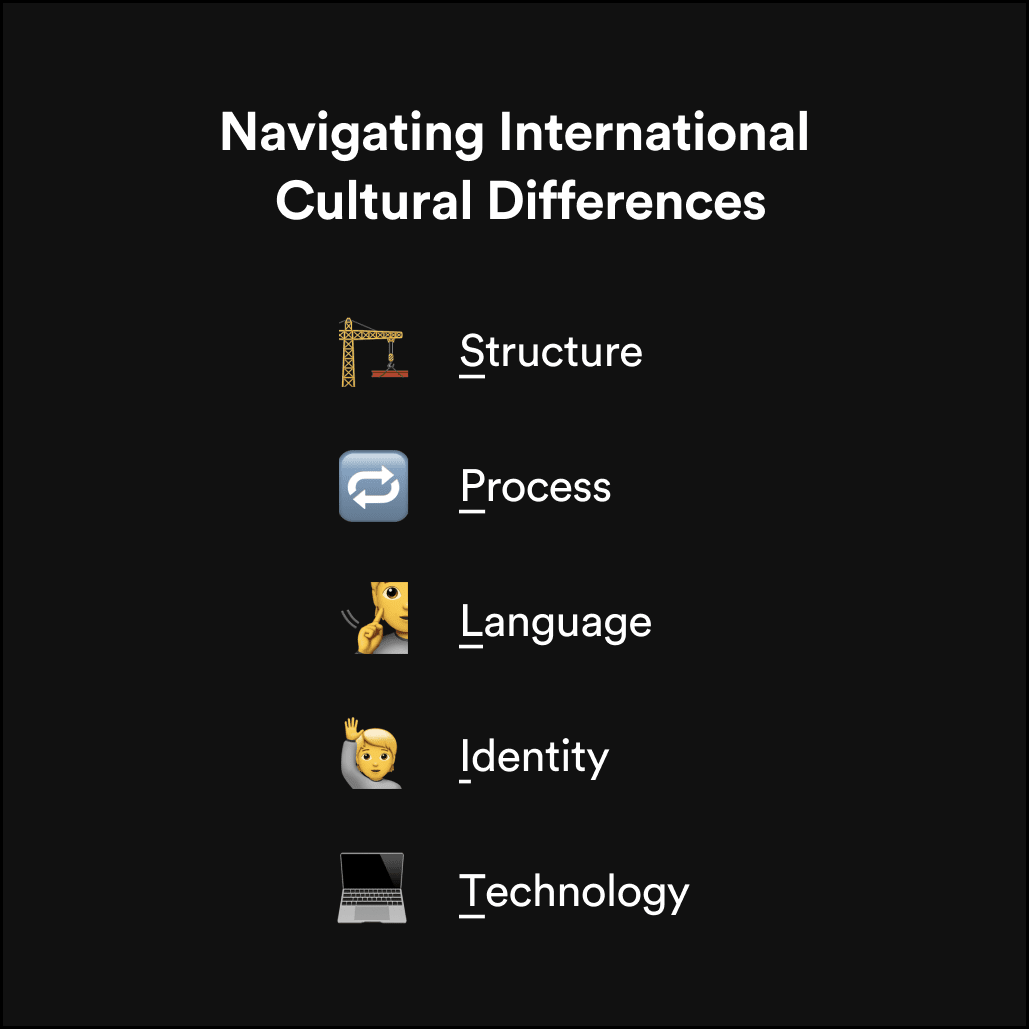
After research and consulting on international collaboration for over 15 years, Tsedal Neeley, Professor at Harvard Business School, developed the SPLIT framework to help:
🏗️ Structure 🔁 Process 🧏 Language 🙋 Identity 💻 Technology
Let’s take a look at each one.
🏗️ S is for Structure
Tsedal defines structure in terms of power. When you have more people from one background or based in one location, they become the “in crowd”.
To minimize the imbalance try: • Emphasizing 3 key messages: We’re one team (who we are). We have shared goals and purpose (what we do). I’m here to support the entire team (I am there for you). • Creating opportunities to share cultural identities, like a virtual “show and tell” where your team members describe a popular film or what breakfast is like in their country. • Accommodating different time zones by rotating meeting times. This helps everyone feel like part of the group.
🔁 P is for Process
This is about making room for empathy and curiosity.
• Give team members an opportunity to express themselves informally by starting meetings with 5 minutes of unstructured conversation. • Offer different outlets to share opinions and provide input – writing down feedback, turn-taking, 1-on-1s are great alternatives to regular meetings.
🧏 L is for Language
Be mindful of differences in fluency in your team:
• Avoid long sentences, acronyms, and jargon • Use diagrams and written explanations • Give people opportunities to participate in real-time and asynchronously so they have time to think.
🙋 I is for Identity
Facilitate a culture of learning with an exercise where team members share different facets of their identities.
Examples:
• “Back home, it would be unthinkable to contradict your boss during a meeting.”
• “In my family, we all enjoy a heated discussion - no one gets upset by a disagreement.”
• “In my country saying “Yes, I can do this” means I’ll give it a try, but I see that here, it means you’re confident you’ll be able to get the job done.”
This kind of exchange helps build identity and minimize misunderstandings.
💻 T is for Technology
Use this to facilitate more personal connections among team members: • video calls • online games • Customizing your tools (hello, Slackmojis!)
💡 Diverse teams = more creativity & innovation
Cultural diversity certainly comes with its challenges but curiosity and openness can go a long way in smoothing out differences.
That diversity is a powerful asset that can give you a competitive advantage - so celebrate the unique background of each team member!
Become a world-class leader in two minutes a day